A note on the making. This page was written for, with, and by AI: drafted by a language model working inside Walter OS, my own memory system, from our write-ups, the event program, the project's technical notes and the tool itself, then directed, read, corrected and approved by me. Nothing here was produced by prompting a model for video. Strata Morpha and Ink Morpha are rendered frame by frame by code, and that code was written with sustained AI assistance, a language model working as a coding collaborator (Claude, in this case), with us setting the direction, judging every render and throwing out what did not hold. The drawings, the poem and the music belong to the artists credited below, and none of it was generated by a model.
Strata Morpha was first shown at Mahk Making Spaces, in the Utzon Room at the Sydney Opera House, on 27 September 2026.
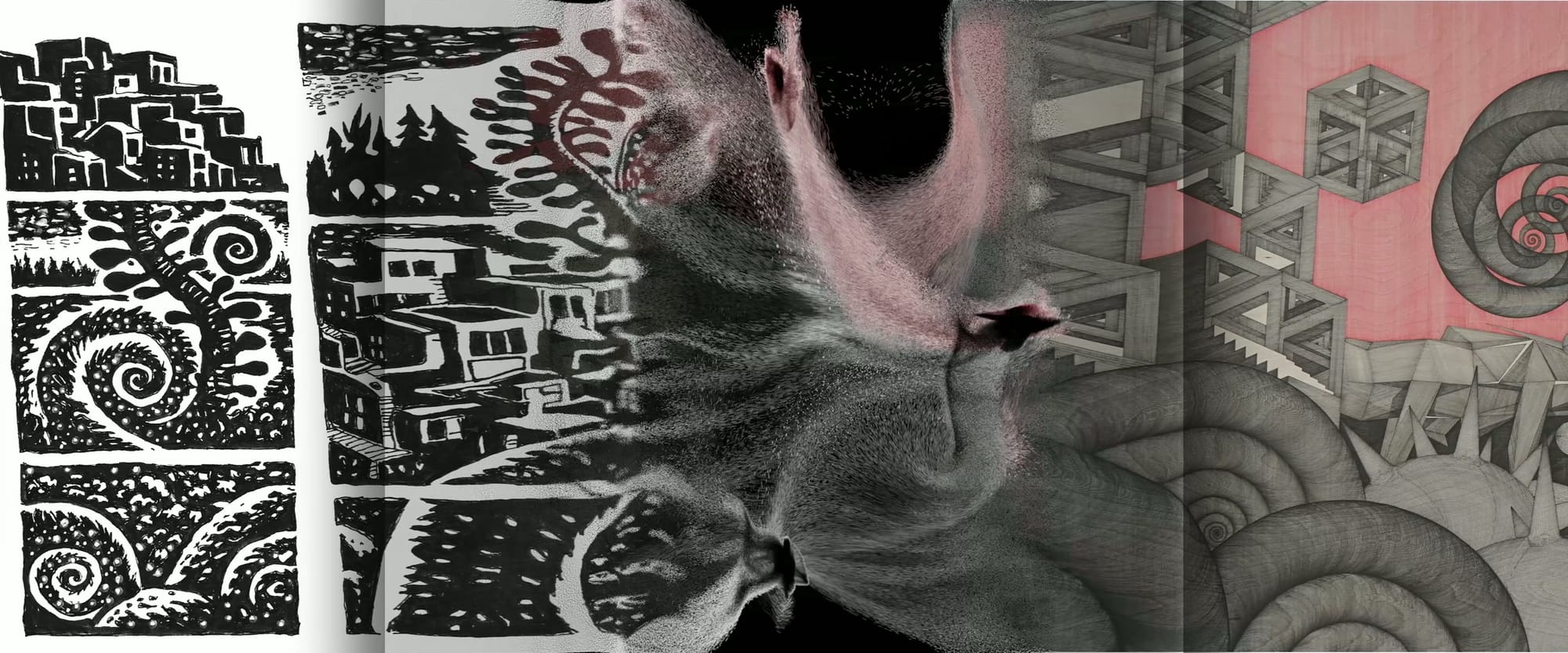
Strata Morpha is a reactive procedural animation rendered through a custom long-scroll system of layering, erosion and rematerialisation. The system filters and combines inputs from multiple creative disciplines. Visual works by Cheolyu Kim are broken down into minute pixel columns and released, carried across an active space until the pixel grid re-forms as work by Chris Fleming. Kim Pham's poem Herb-lore for a Cyborg informs the piece, while Brendan Smyly's soundscape sets the pace and dynamics of the forces influencing the material during the crossing. Strata Morpha does not seek to add imperfection, but if the source material or the crossing throws up something rough or unresolved, it does not correct it, though the material must still land at its destination.
The crossing
Neither drawing is ever seen whole. Cheolyu Kim's and Chris Fleming's works were stitched into two long strips, each nearly nine screen-widths of pen on paper, and each strip scrolls slowly past the frame. Kim's work enters through a narrow slit on the right, where every column of pixels lifts off the page as particles, crosses the open middle of the frame (what we came to call the 'mid-space') and re-forms on the left as a column of Fleming's drawing. Either side of the crossing, a stretch of each drawing sits intact in its own window: Kim's on the right before it lets go, Fleming's on the left once it has landed. The strips are the same width and every column takes the same time to cross, so every column of one drawing becomes the matching column of the other, exactly. Nothing is lost on the way. It is only displaced.
The piece runs the length of Brendan Smyly's soundscape, and the soundscape is in charge. We pulled the recording apart ahead of time into its behaviours (its attacks, its loudness, the weight of the low end against the body, its brightness, noise against tone) and let those drive the forces in the mid-space. A ring of poles, alternating vortex and sink, turns slowly as the balance of the sound shifts. Four attractor rings each listen to a different part of the sound. One of them barely shows up at all. It waits for the brief hole where the music drops out, the one genuinely sparse moment in a recording that is otherwise continuous texture, and only then does it have its say.
The render is deterministic by design. Every frame is a function of its frame number and nothing else, so rendering it twice gives the same file. That mattered more than we expected. When nothing is left to chance, every change on screen has a cause, and the cause can be found. That turned out to be both a gift and a very long list of homework: the system still surprises you, just never without a reason.
The system
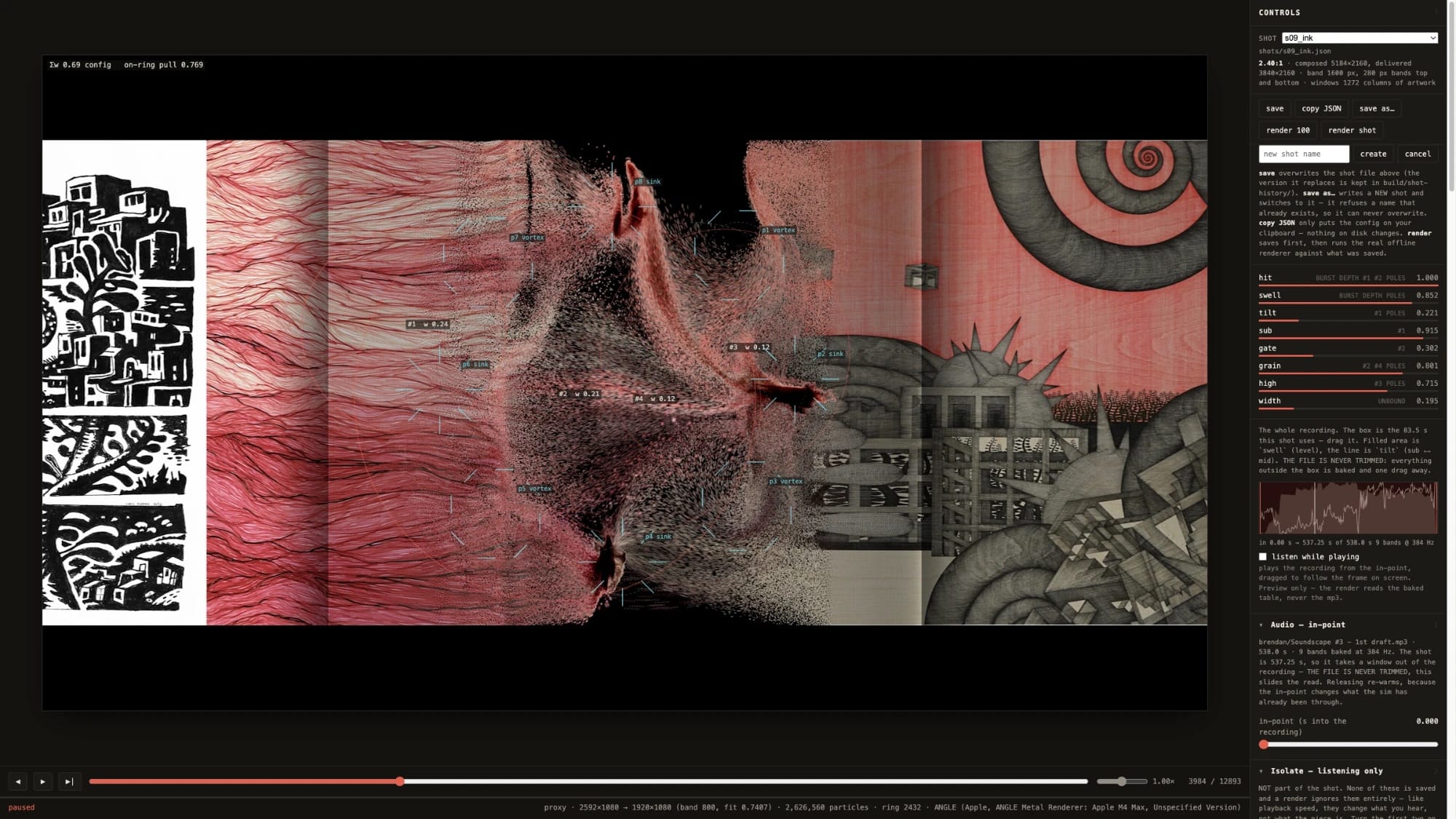
Strata Morpha wasn't made in an animation package. We built the tool that makes the piece, and in a sense the tool is as much the work as any single render. A WebGL2 particle simulation runs in the browser, a small server catches each finished frame, and the frames are encoded out to 4K ProRes masters. Even at working resolution the preview carries more than two and a half million particles. Around it sits a live control surface of eighteen panels and a couple of hundred parameters:
- the audio, with a band, gain, bias and smoothing for every reactive channel
- pace and transit
- the coherence that decides when material lets go and when it lands
- four attractor rings and a ring of eight flow poles
- springs, splat, depth, colour crossover and the two screens
- a panel for each of the mid-space behaviours
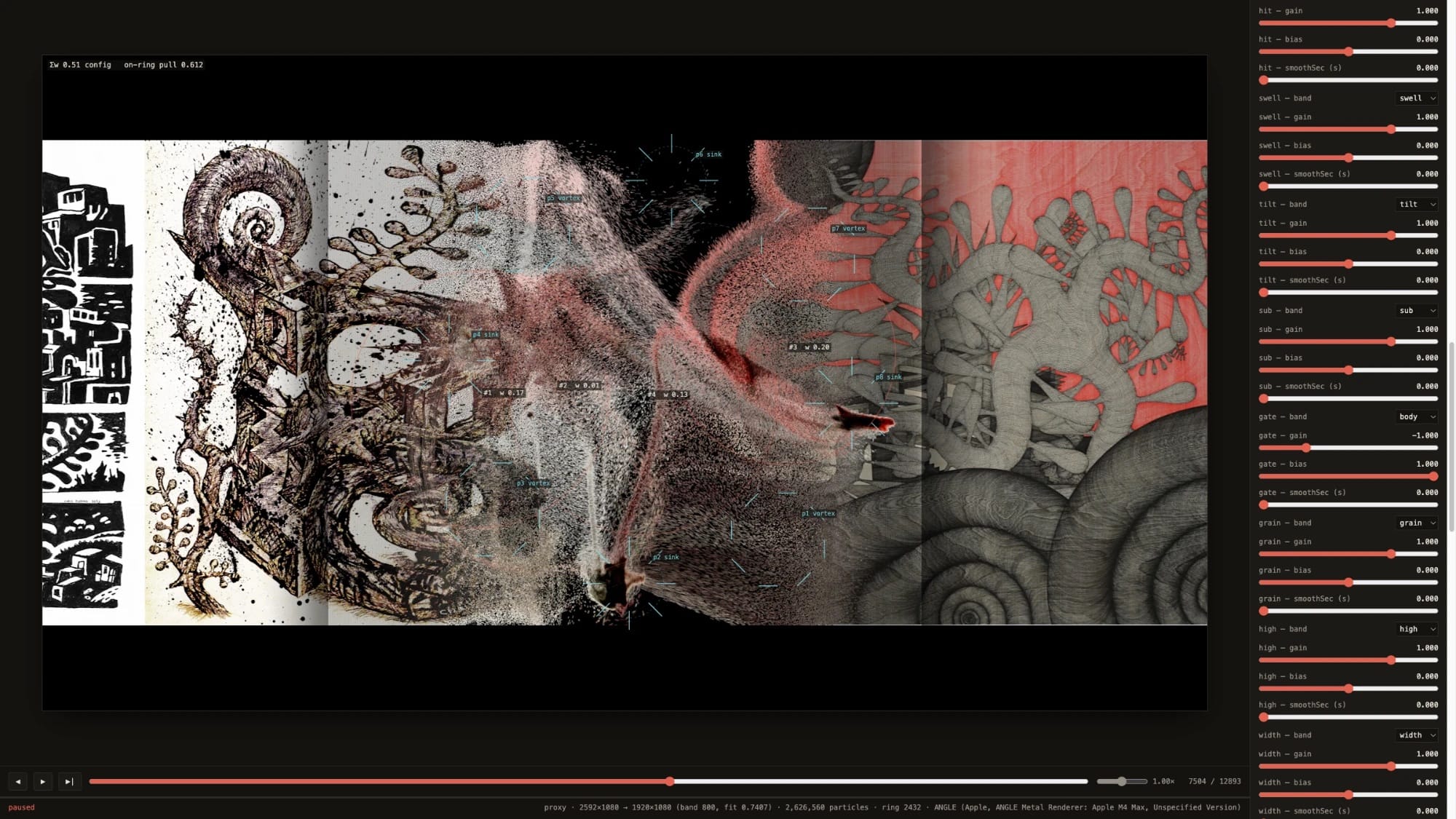
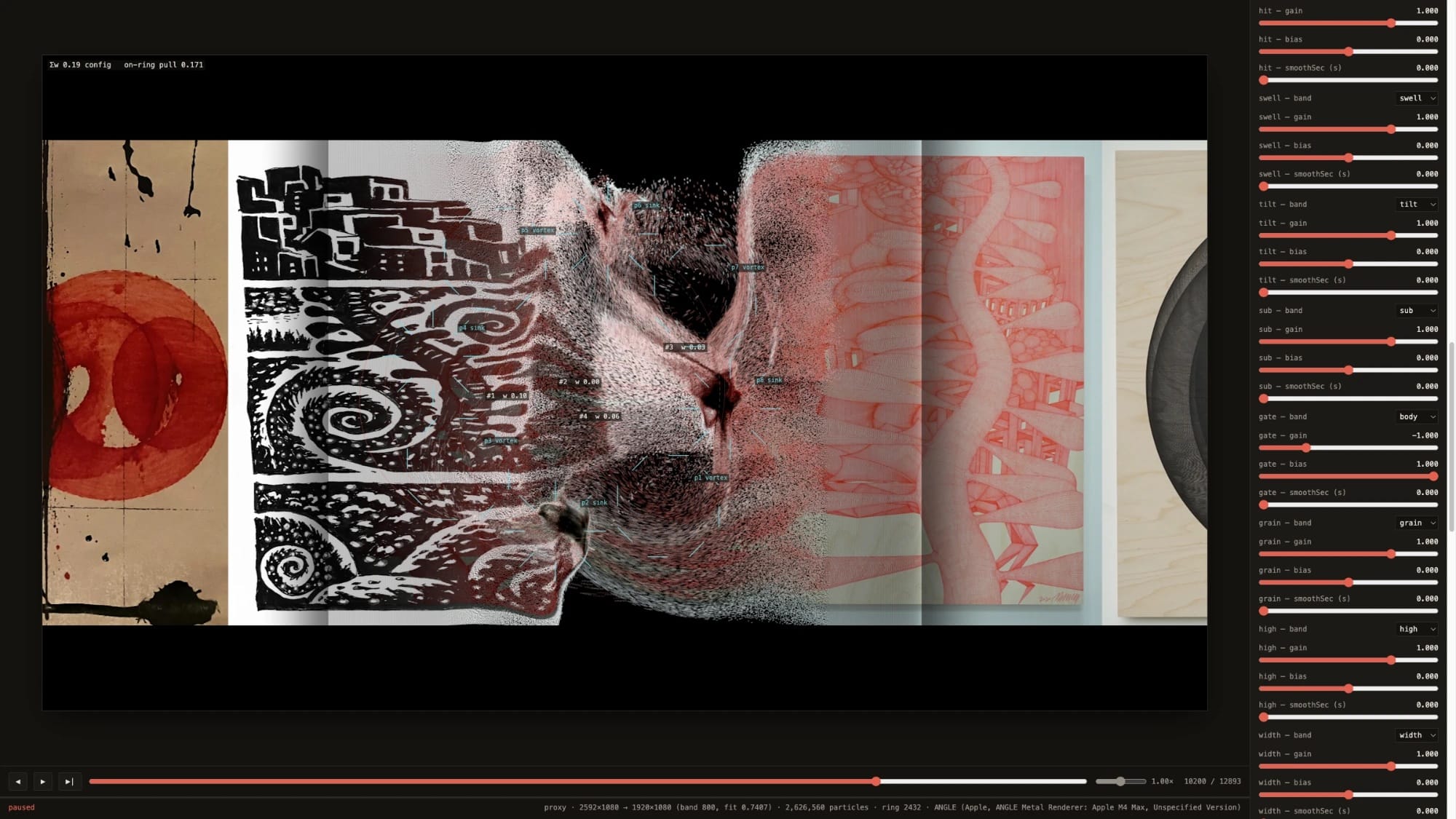
None of those sliders were laid out by hand. They are generated from each behaviour's own manifest, so a new force arrives with its controls already attached. The preview drives the same renderer as the final output, with nothing re-implemented, so what you see while tuning cannot disagree with the file. That was the point: an instrument you can trust while playing, rather than one you have to second-guess. The whole recording is laid out as a strip you drag to choose what the piece hears, and you can listen along while it plays. Overlays label every pole as vortex or sink and show each ring's live weight beside the part of the sound driving that ring. A behaviour's shader reloads on save and takes hold of particles already mid-crossing, so a change lands in the middle of the flow rather than back at the start. Saving writes to the shot file and keeps the version it replaced, and one button then runs the real offline renderer on exactly what was saved.
Deciphering the pixels
Most of the work on the ink version wasn't adding things. It was sitting with the piece, watching it run again and again, and working out why the pixels behaved the way they did. Nearly all of that started as a question asked while watching, and most of the answers were already on the screen.
The first question was about pace. Watching drafts played back slower than real time, the piece felt right, and we wanted that feeling in the render. Slowing the transit, so particles took longer to cross, didn't bring it back. Pulling it apart, we found four separate 'clocks' running on screen at once: the scroll of the drawings, the crossing of the mid-space, the speed at which particles react and settle under the forces acting on them, and the soundtrack's hold over those forces. Slowing playback slows all four together. What we had actually liked was the third, and the third had no control at all. So we built one, a control that slows how material in the mid-space answers the field while the scroll, the crossing and the music keep their pace. The field still moves at full speed; the material just responds as if it were wading through something thicker. In short, we wanted the material slowed, not the piece.
The second question was about the two thresholds, where material lets go of one drawing and lands in the other. Every particle in a column had been leaving at exactly the same line and arriving at exactly the same line. Those were the only moments in the whole crossing where a column moved in lockstep, and they read as a cut, a hard edge in a piece that is otherwise all erosion. Now each particle draws its own small delay. It can hold on to the page a little longer before it goes, or settle a little early when it arrives, but never the reverse. The edges fray instead of slicing.
Ink
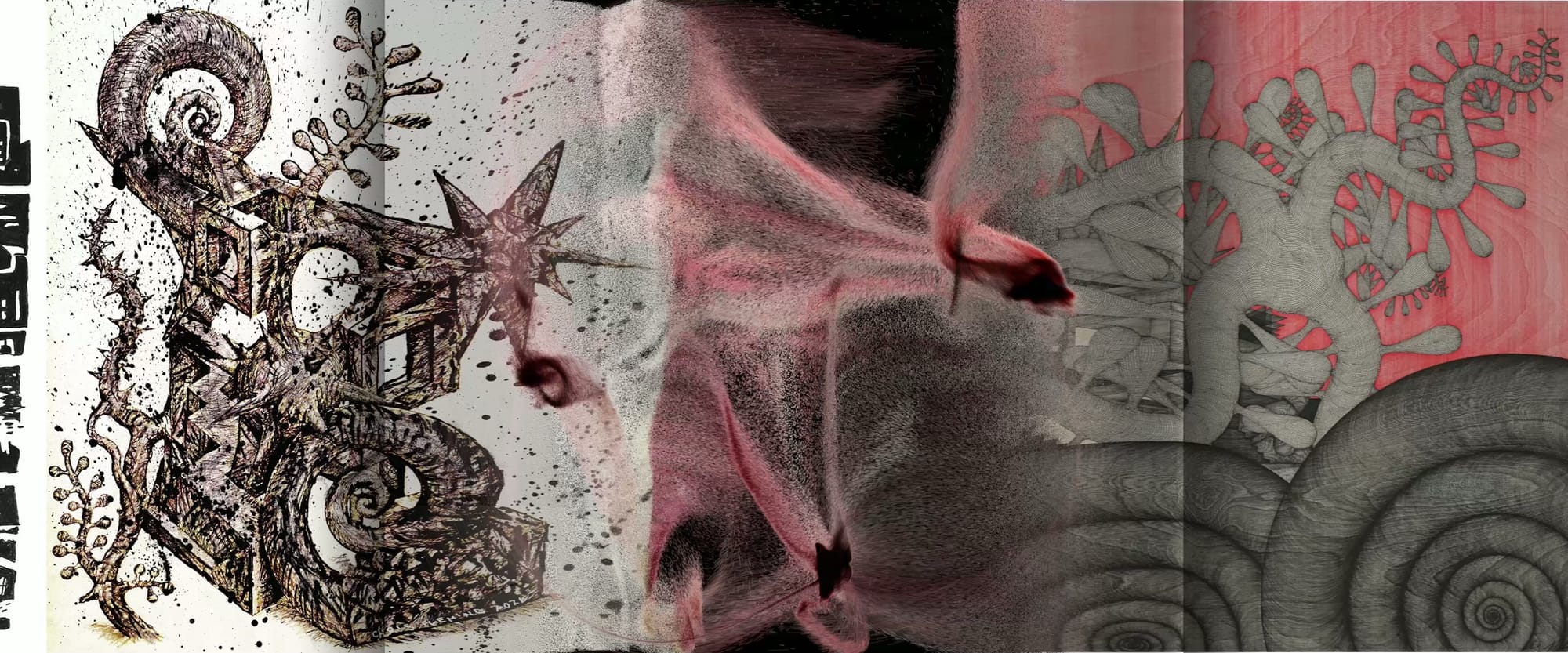
The question that gave this version its name was a simple one, and slightly embarrassing in hindsight: why are there no dark particles around the poles?
The answer was baked into how the image was made. Each particle adds its colour to the pixel it lands on, and black adds nothing. Sparse areas stay dark because little has landed there, and dense areas can only ever get brighter because everything that lands adds light. Where the sinks gathered material into knots, the knots blew out to white. Thousands of dark particles from the pen lines were certainly in there. They just had no way to pull a pixel down.
Our first answer was a soft shoulder, a kind of gentle ceiling that compresses the brightest, most crowded pixels. We pushed it from barely there to heavy-handed. The highlights came down and the darks didn't move at all, so the shoulder could tame brightness but never make darkness. The deeper reason was sitting in the drawings themselves. They are pen on white paper, so most particles carry near-white, and any average of gathered material is near-white too. Averaging cannot make black.
Only absorption can. Ink on paper doesn't add light, it takes it away, and layers of ink take away more. So we changed the final pass of the render: a crowd of particles is no longer treated as accumulated light but as stacked layers of filter, each layer letting through only part of the light. White paper stays white however much of it piles up, while a pen stroke a few layers deep goes almost black. Density became darkness. The blown highlights came back under the ceiling too, and that wasn't tuning; a filter simply cannot make anything brighter than white. After living with it for a while we eased the ink back, so the knots read as weight rather than as holes.
The change itself was tiny, a few lines of code, built from information the renderer was already writing. That pattern kept coming back: what looked like missing behaviour was often information the system already held but wasn't using.
What the field was actually doing
The same habit, measuring before deciding, overturned an assumption we had held for a long time. We had thought of the mid-space as shaped by its attractor rings, and kept asking why the rings didn't read as rings. So we measured ring structure directly, as the density of material around each ring's centre, and switched forces off one at a time. Turning the rings' orbit off entirely barely changed that structure. Nearly all of it belonged to the poles. The sinks empty their centres and gather material into arcs, and that is the circular structure you actually see. Weakening the poles to 'reveal' the rings made things worse every time, and removing them left a flat, uniform field. This is not to say the rings do nothing, but rather that they were never the shape. They are the weather passing through.
Even the frame you choose to measure matters. Our first test frame happened to fall in a passage where most of the rings were nearly silent, and it handed us two confident conclusions, both of which reversed once we measured a representative frame instead. A few of the piece's most careful decisions came out of mistakes like that, and out of the measurements that stopped us acting on them.
Leaving it rough
The ink is not perfect, and we left it that way. In the windows where the drawings pass through untouched, the ink pass nudges a scattering of pixels by the smallest step of brightness the image can hold, rounding residue from the arithmetic rather than anything in the drawings. We could have hidden the residue. But it is part of the material passing through the system, and Strata Morpha doesn't correct what the crossing throws up. If anything, it could be said that the residue is the system's own trace on the drawing, left as faithfully as the drawing leaves its trace in the system. The material still has to land.
Versions
Four versions of Strata Morpha were prepared for the night from the same system, the same drawings and the same soundscape. The ink version above, particles only, was the focus piece. The other three lay a treatment over the artwork.
Plate screen
A halftone screen is laid over the drawings in the two windows. The screen never resamples or enlarges the artwork. It only decides which of the drawing's own pixels get to stand, so the plates break into blocks of drawing and paper as they enter and leave the crossing.
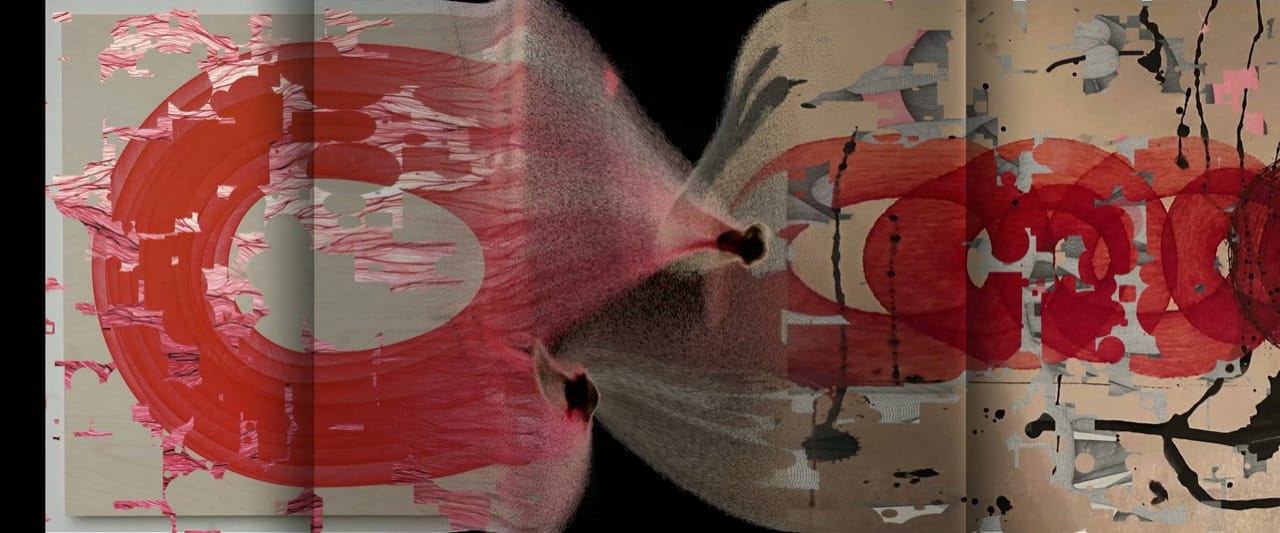
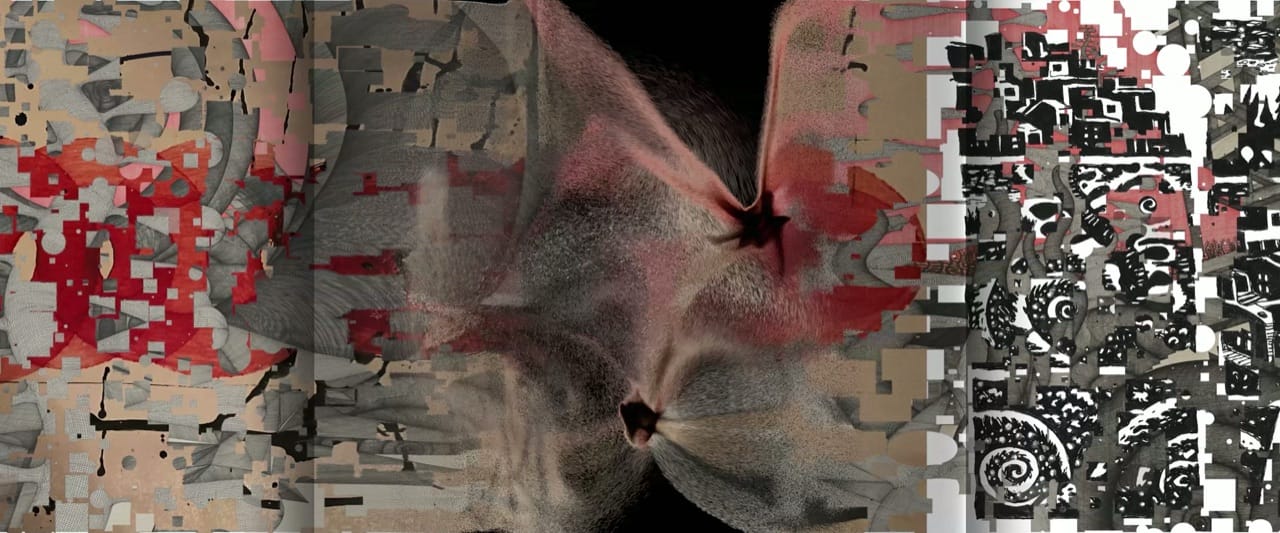
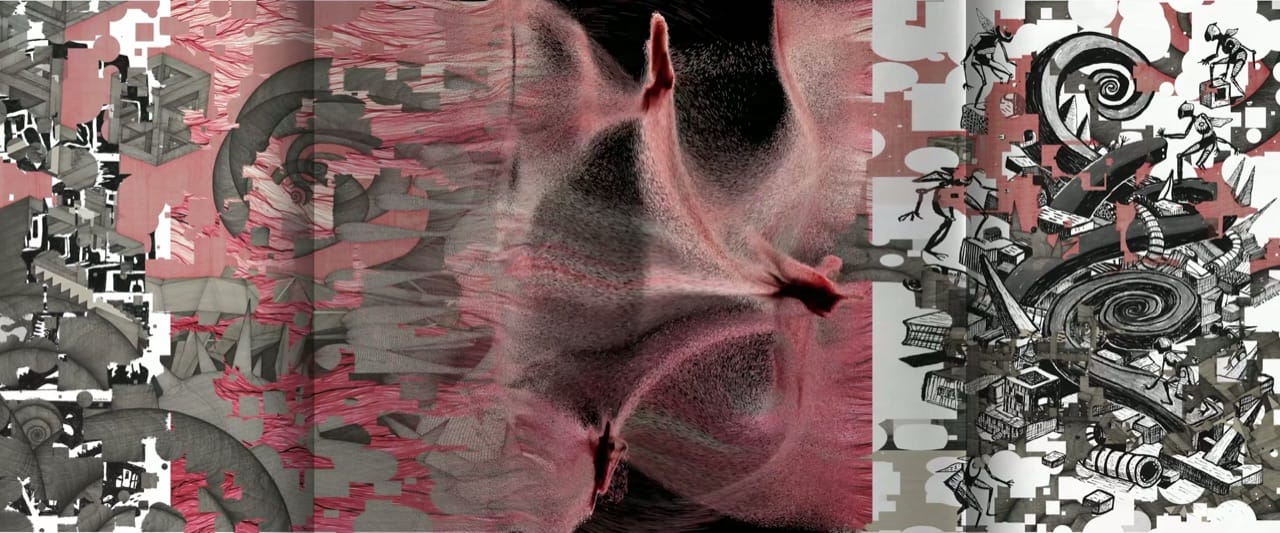
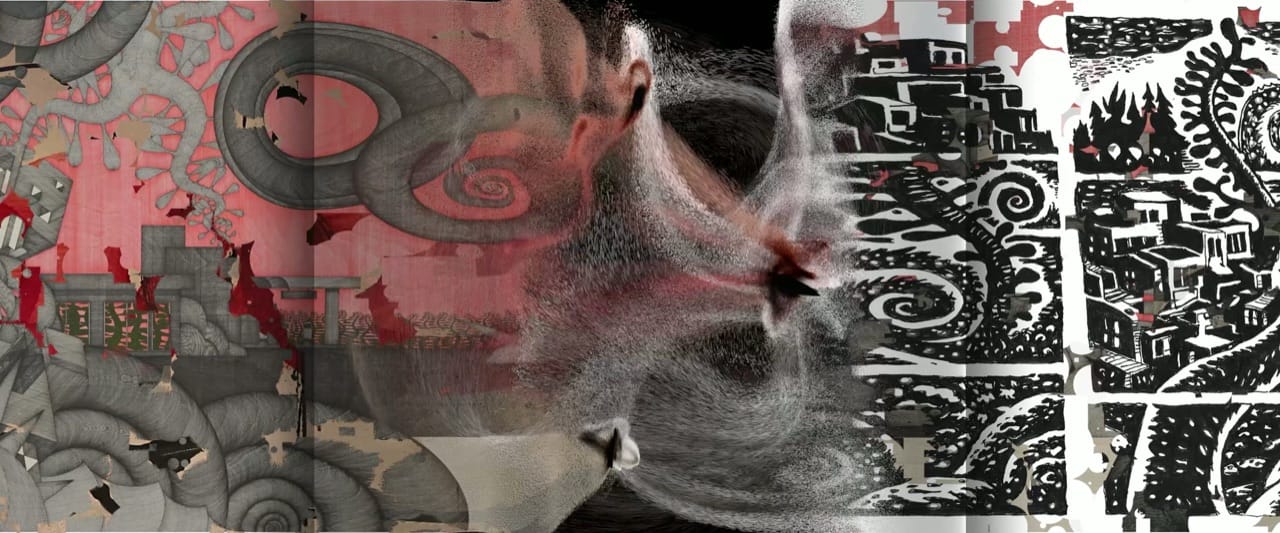
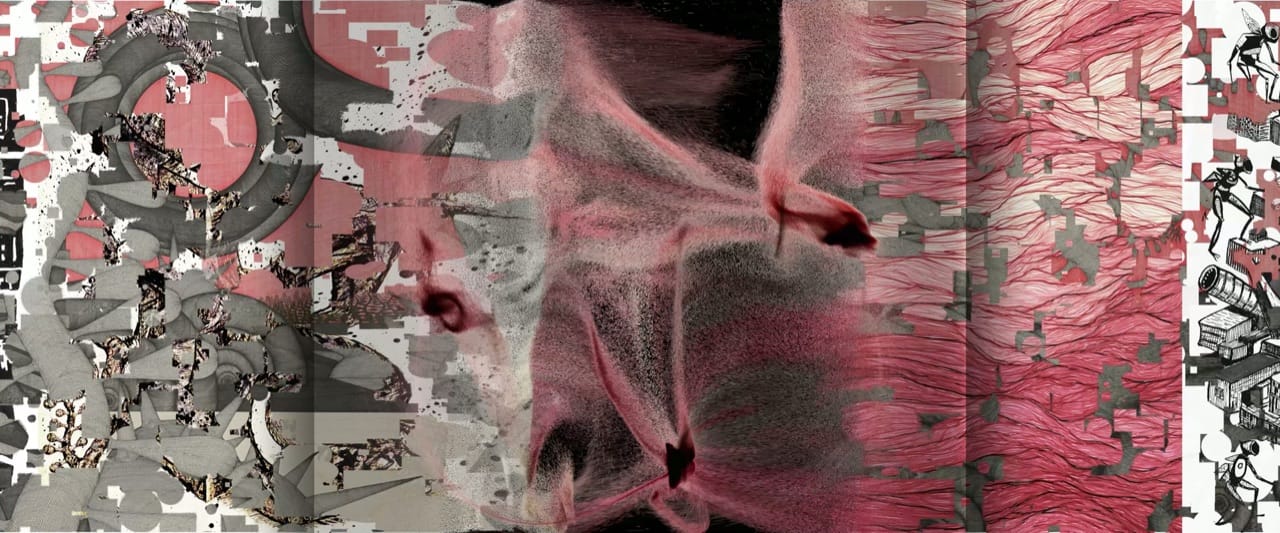
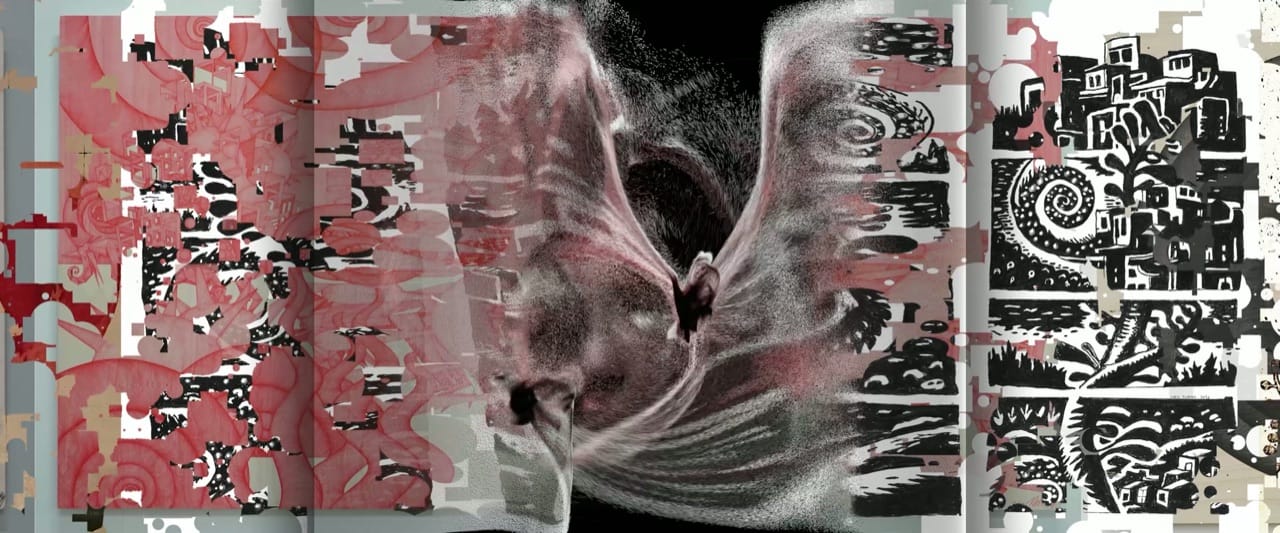
Strata Morpha, plate-screen version. The halftone breaks red rings, linocut and pink line-work into blocks at the edges of the crossing, while the mid-space stays untouched.
Poem: plate and mid-space text
Lines from Kim Pham's Herb-lore for a Cyborg are set into the drawings and released into the mid-space with everything else. The words break apart, smear and repeat as they cross, and arrive at the other side as fragments.
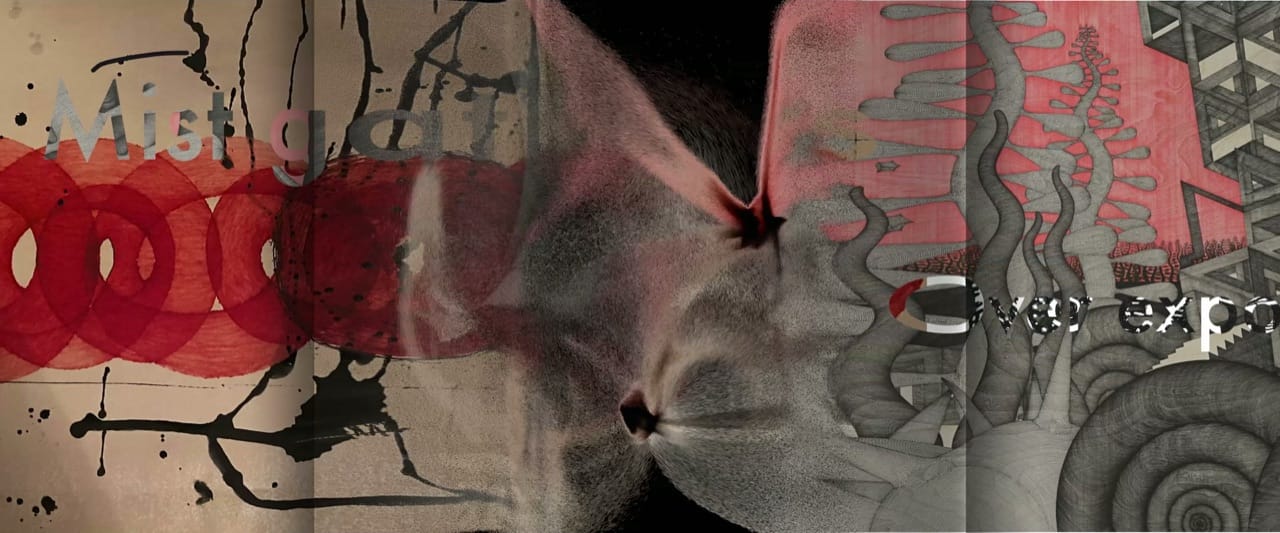
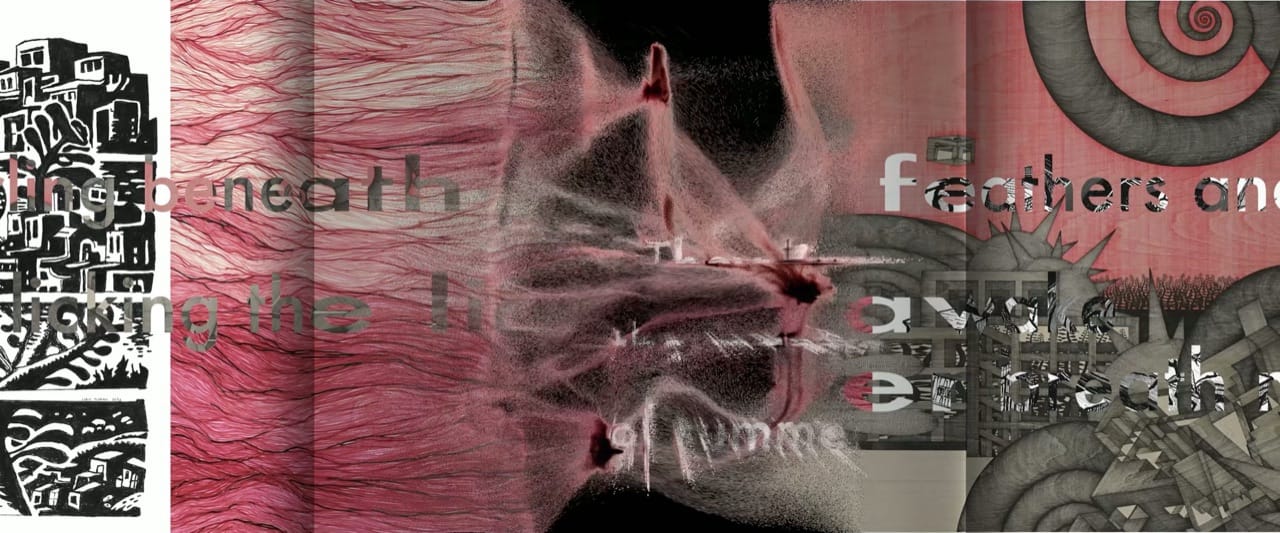
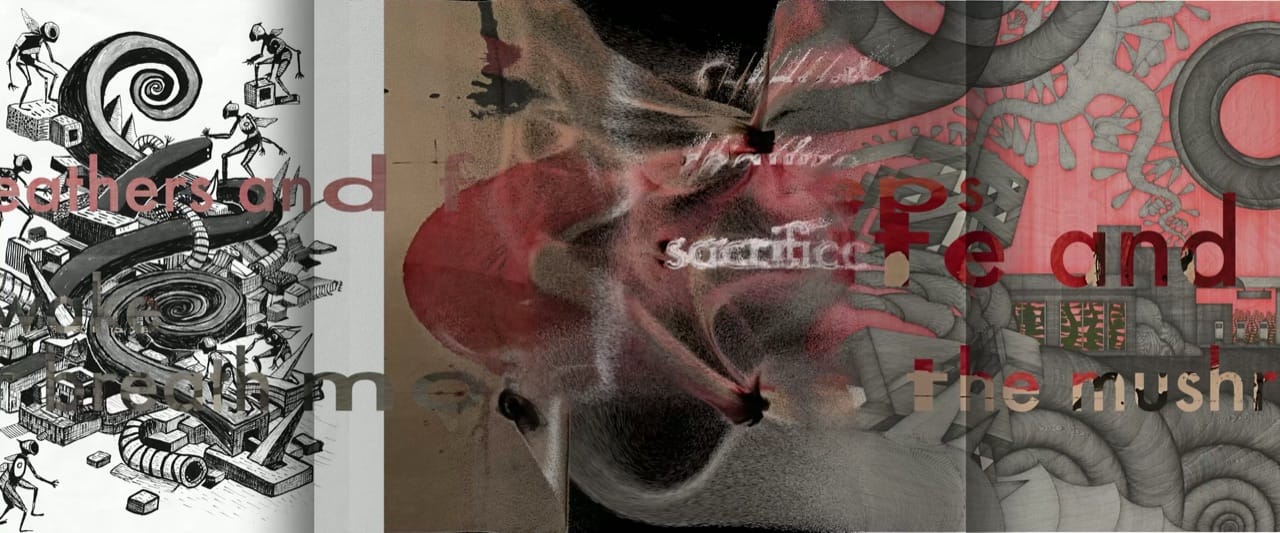
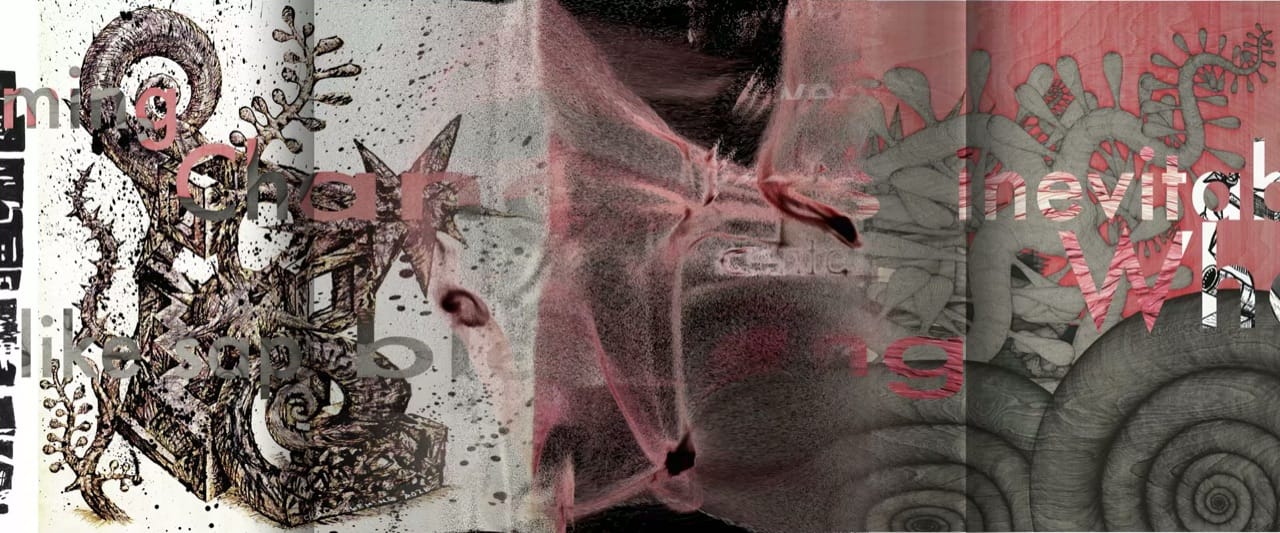
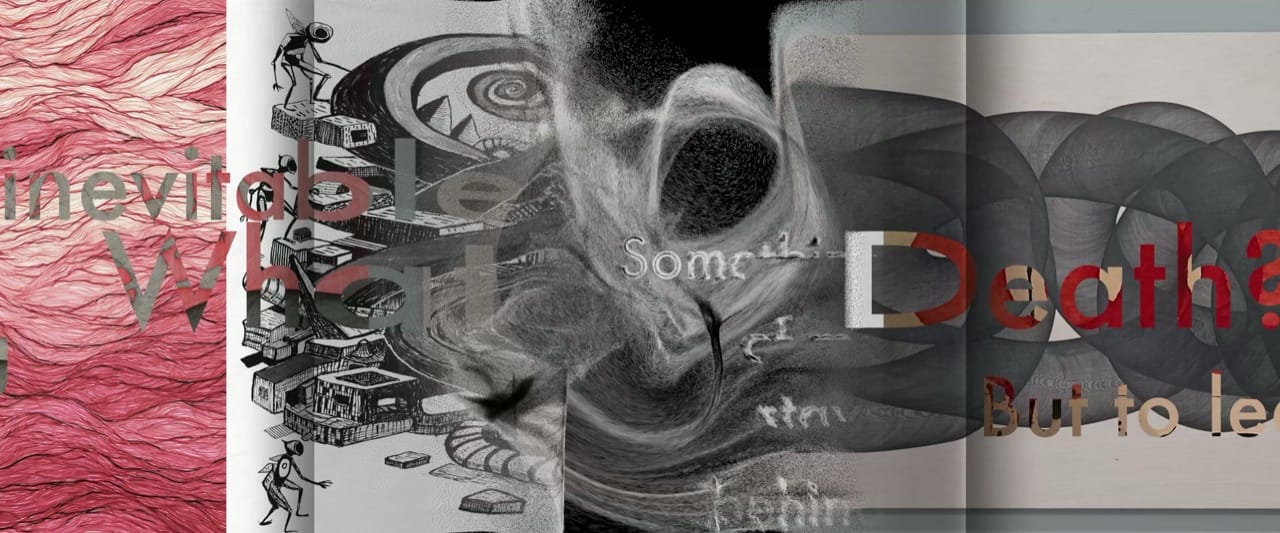
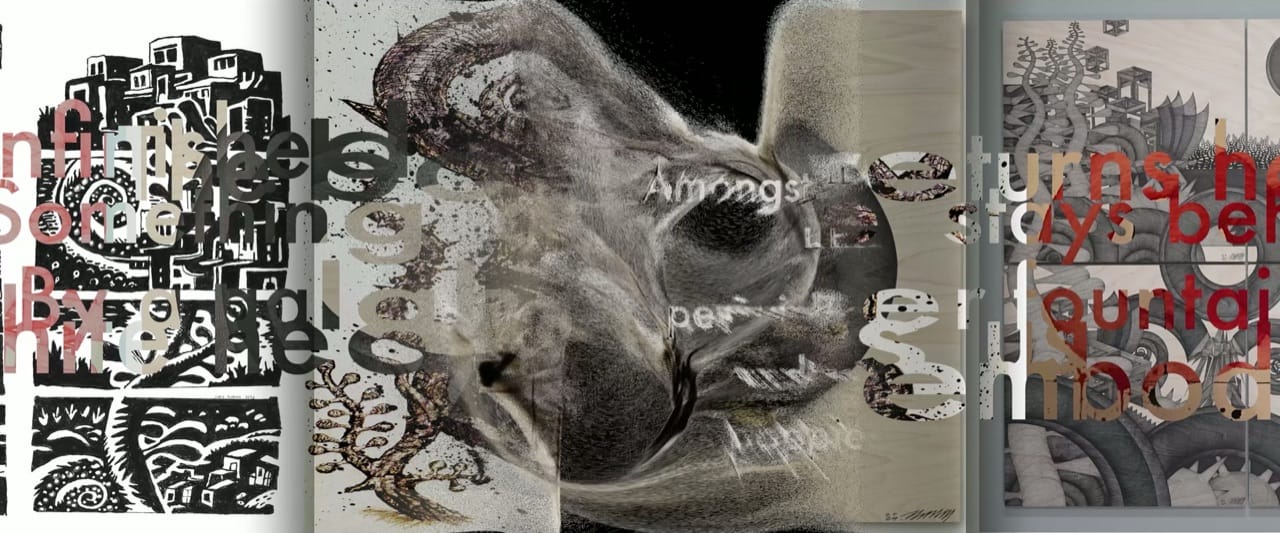
Strata Morpha, poem version with text in the drawings and the mid-space. In one frame "…ling beneath / licking the…" sits on one plate and "feathers and…" on the other, while the crossing tears the line between them apart.
Poem: plate text only
The same lines, carried on the drawings alone. Here the text dissolves and re-forms with the artwork rather than being added to the crossing.
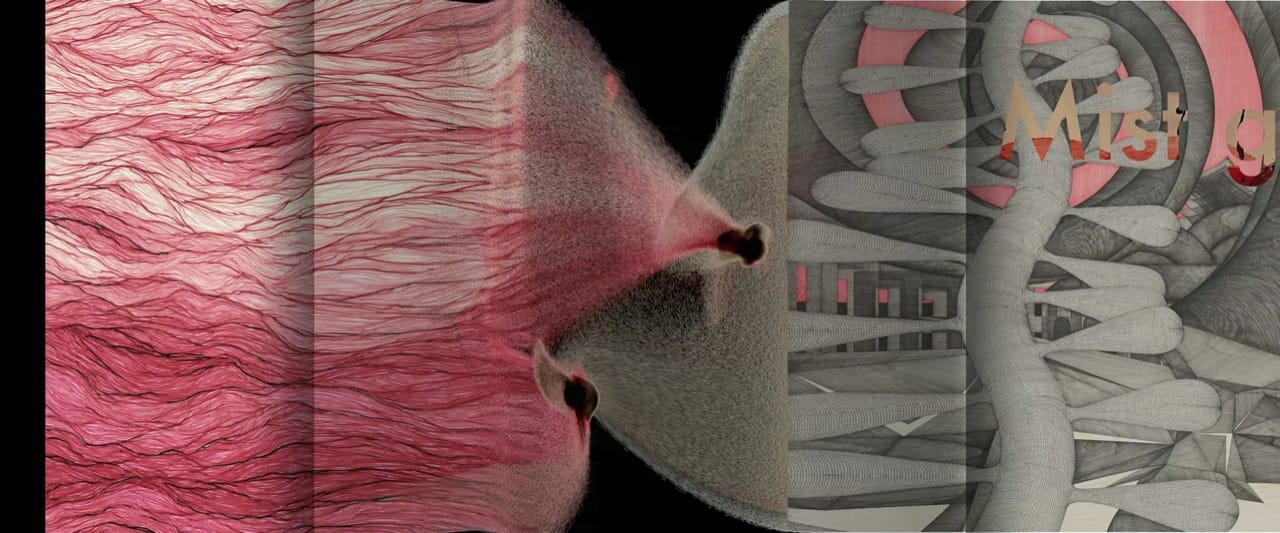
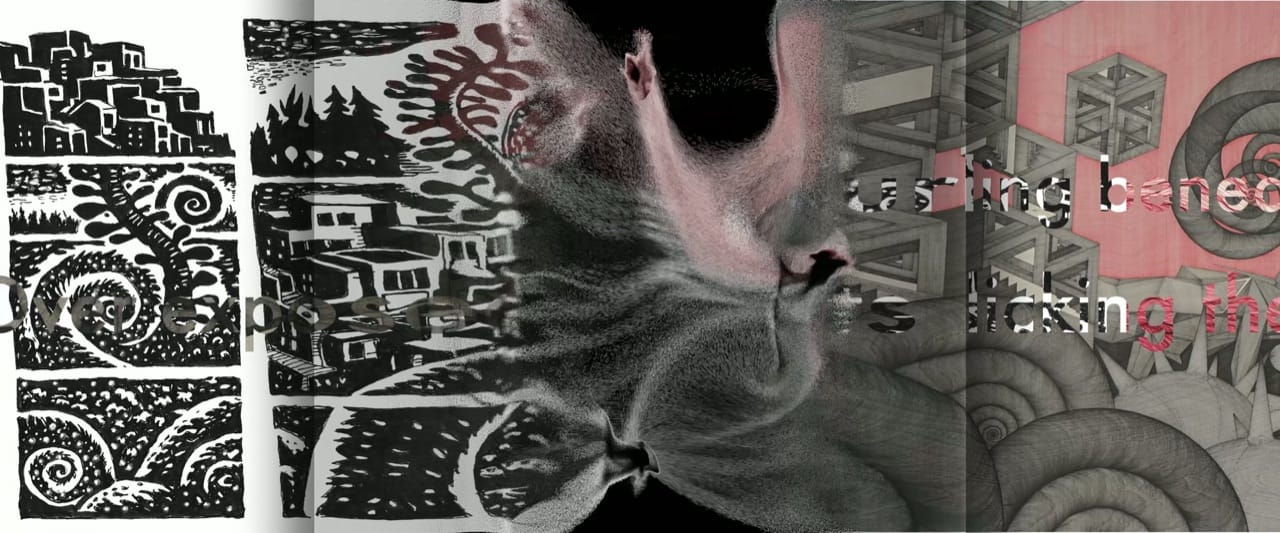
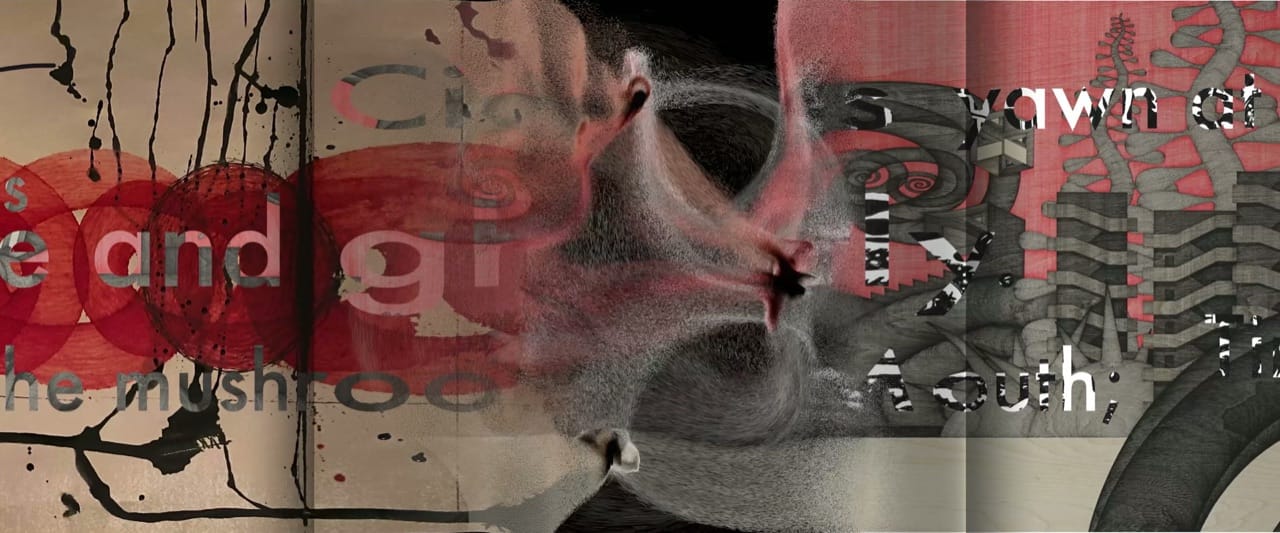
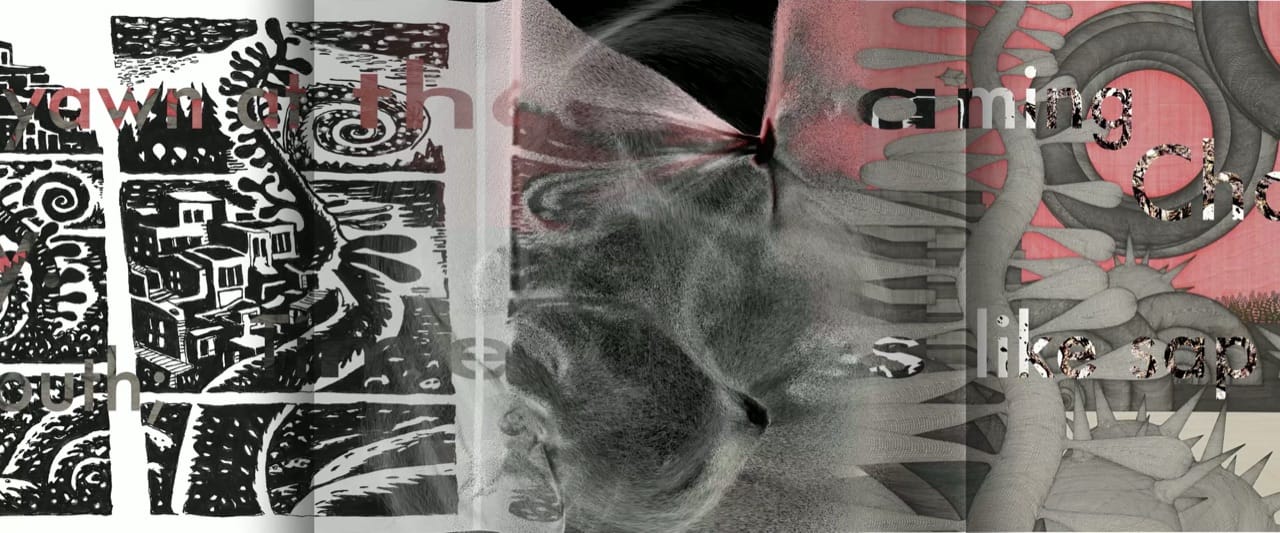
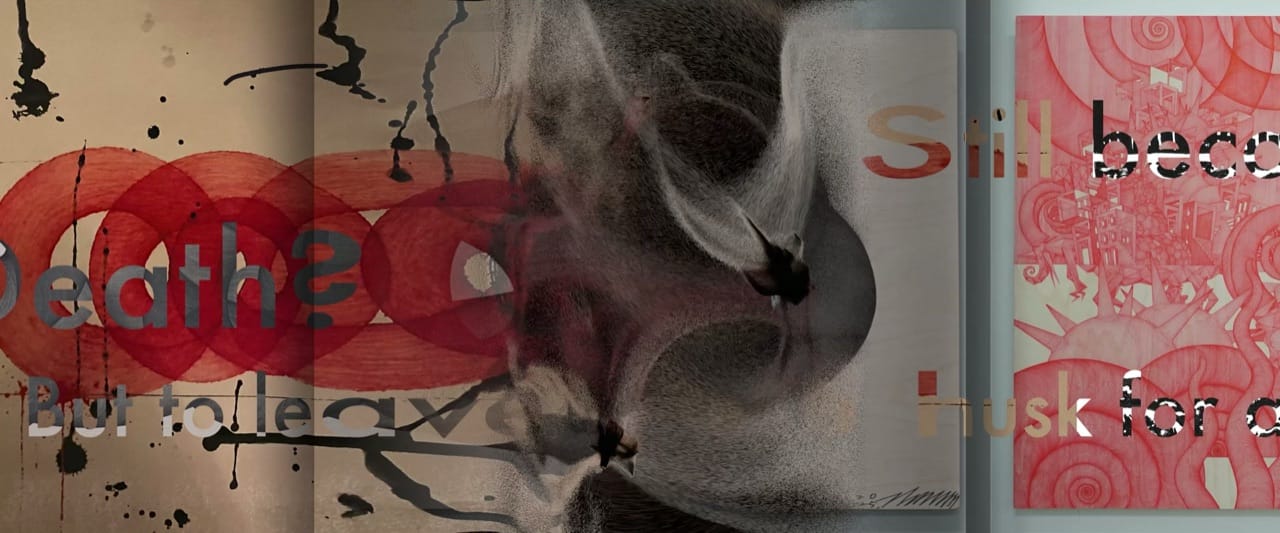
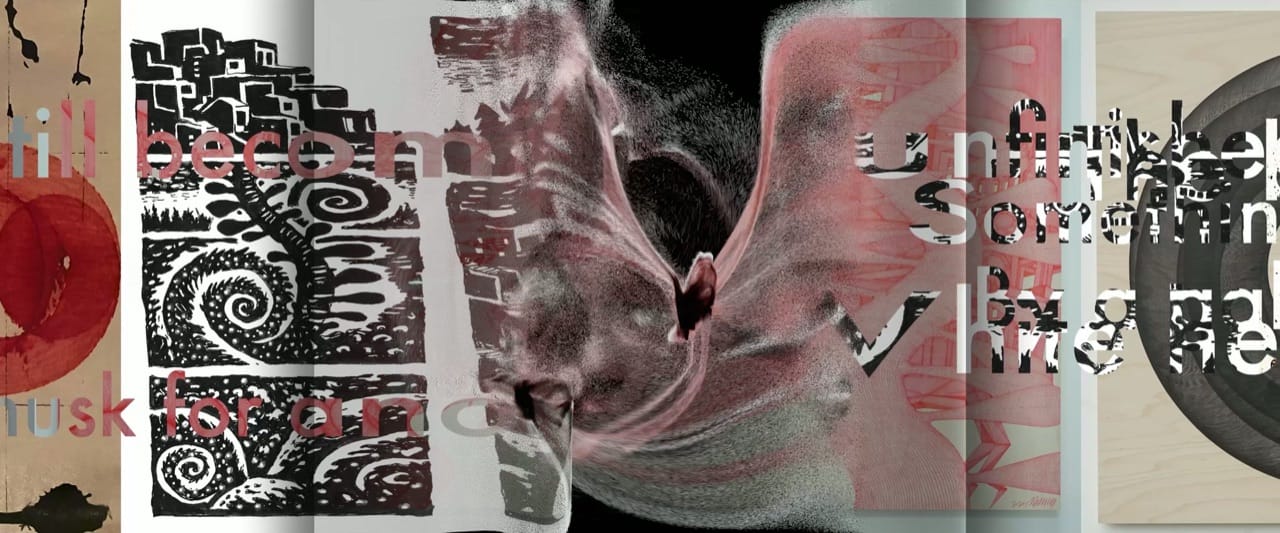
Strata Morpha, plate-text version. Fragments of the poem ("Mist…", "Death?", "husk for a husk") ride in on the drawings, break up in the mid-space and return.
Ink Morpha
Behrad Rezaei and Greg Hughes
Ink Morpha is a reactive procedural ink painting rendered through a custom system of splashing, bleeding and drying. The system listens to Bruce Crossman's Mahk Resonances and Emergent Moon, played on the guzheng by Tang Yuyan, and answers every note with a splash of black ink on white xuan paper, blooming as ink does in water. Where the ink dries, a work by Cheolyu Kim is what it leaves behind, revealed whole in black and white with another of his works merging in, then coloured by whatever crosses it: a brush stroke, a red carp, an unseen current, the rain. The red torus, the emergent moon, is the last to appear; two strokes then meet and the black ink covers the page. Ink Morpha does not place the ink. The music does, to a recording or live in the room, and where a note falls is where the picture forms. What the ink uncovers is not corrected: the work is whatever it leaves behind.
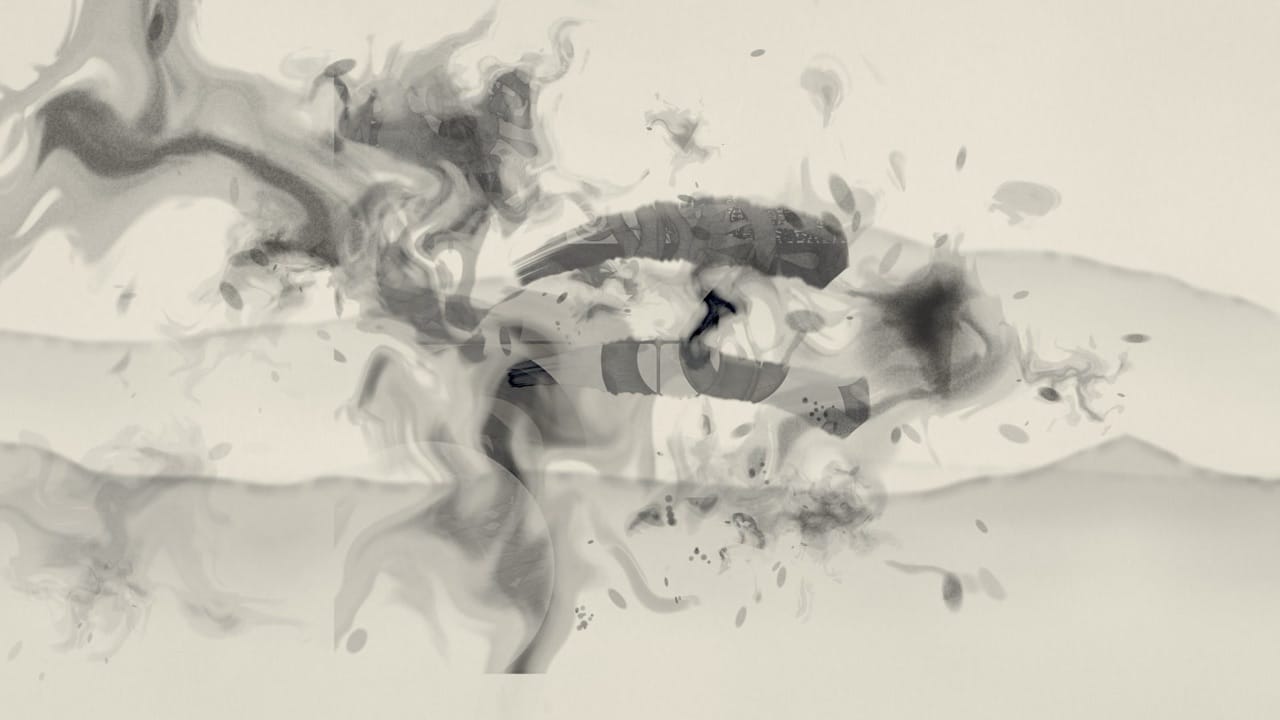
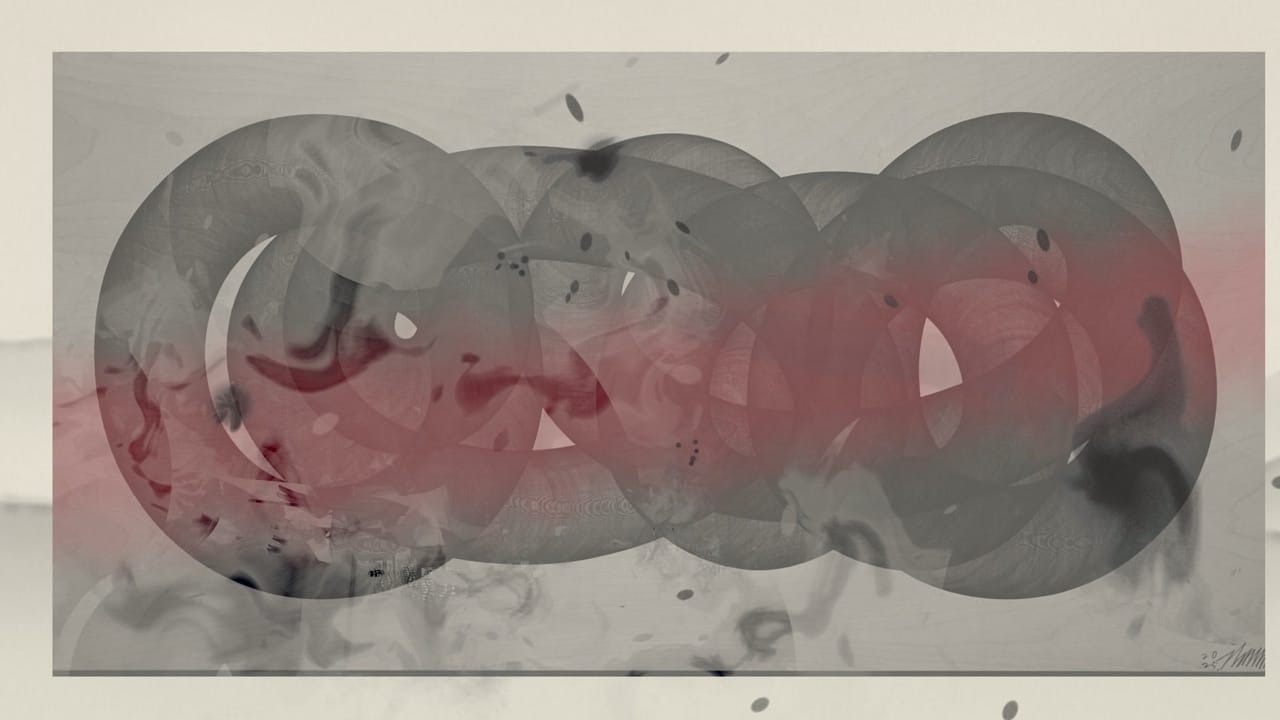
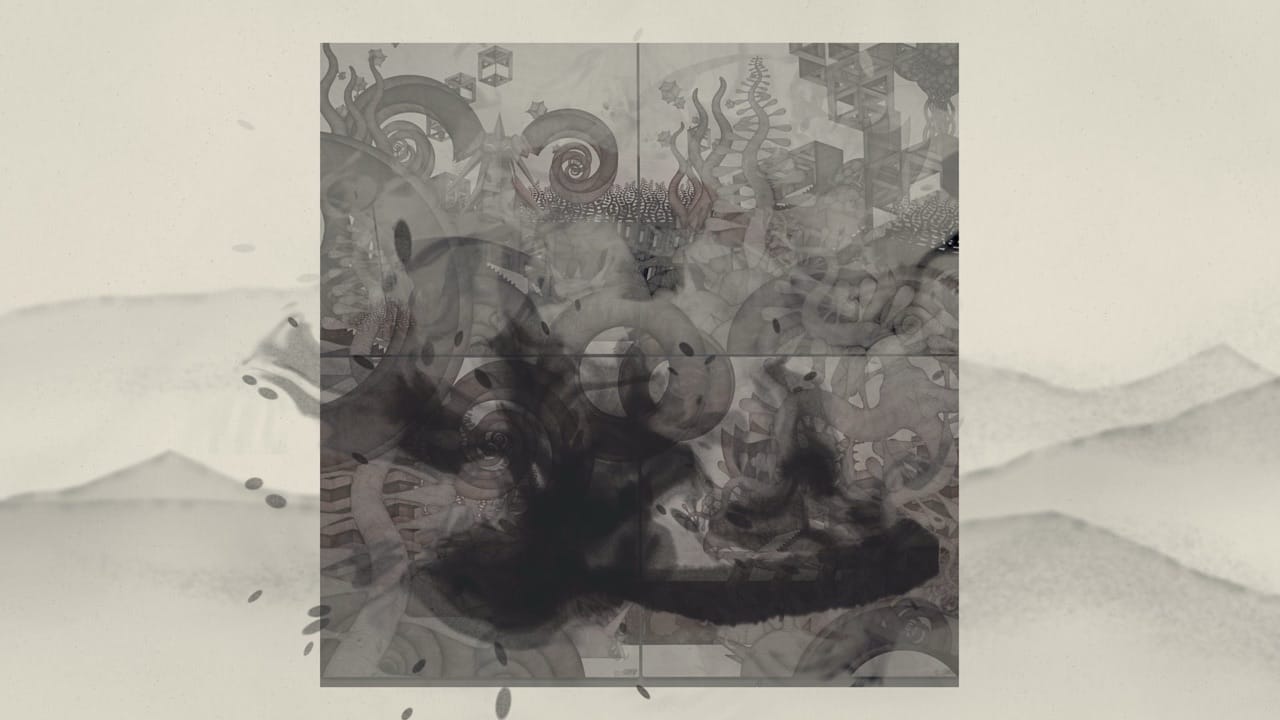
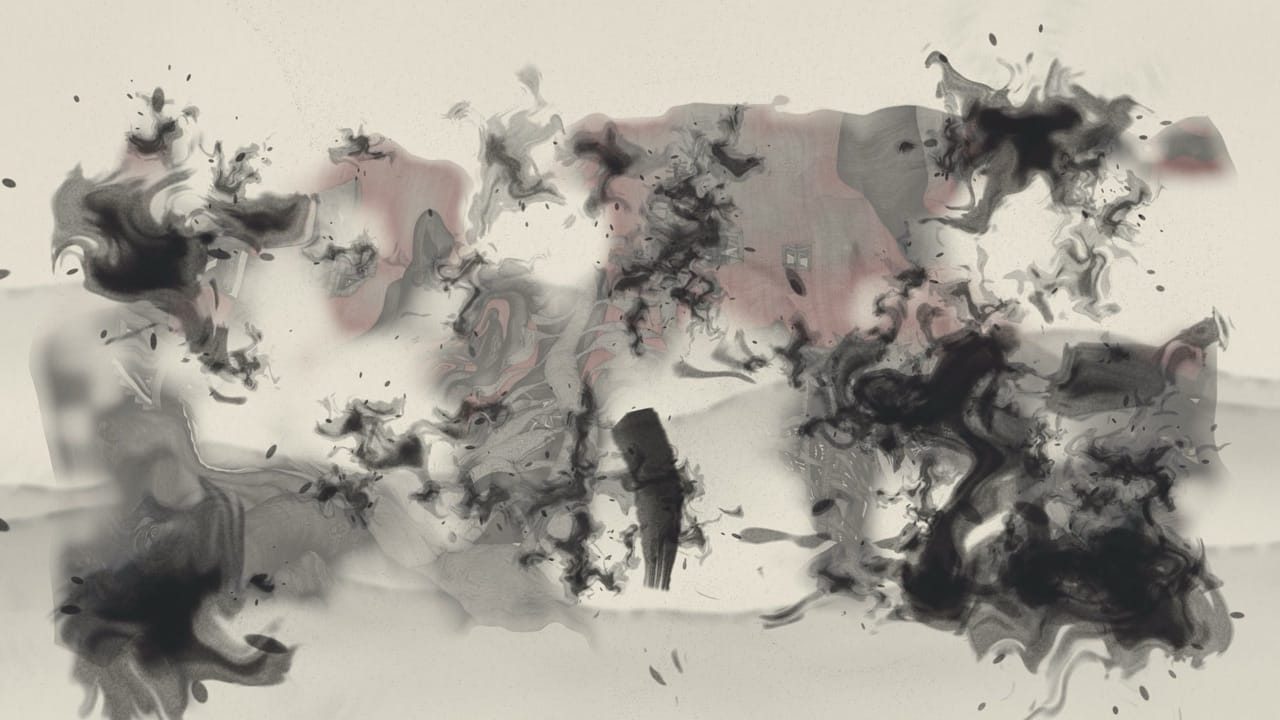
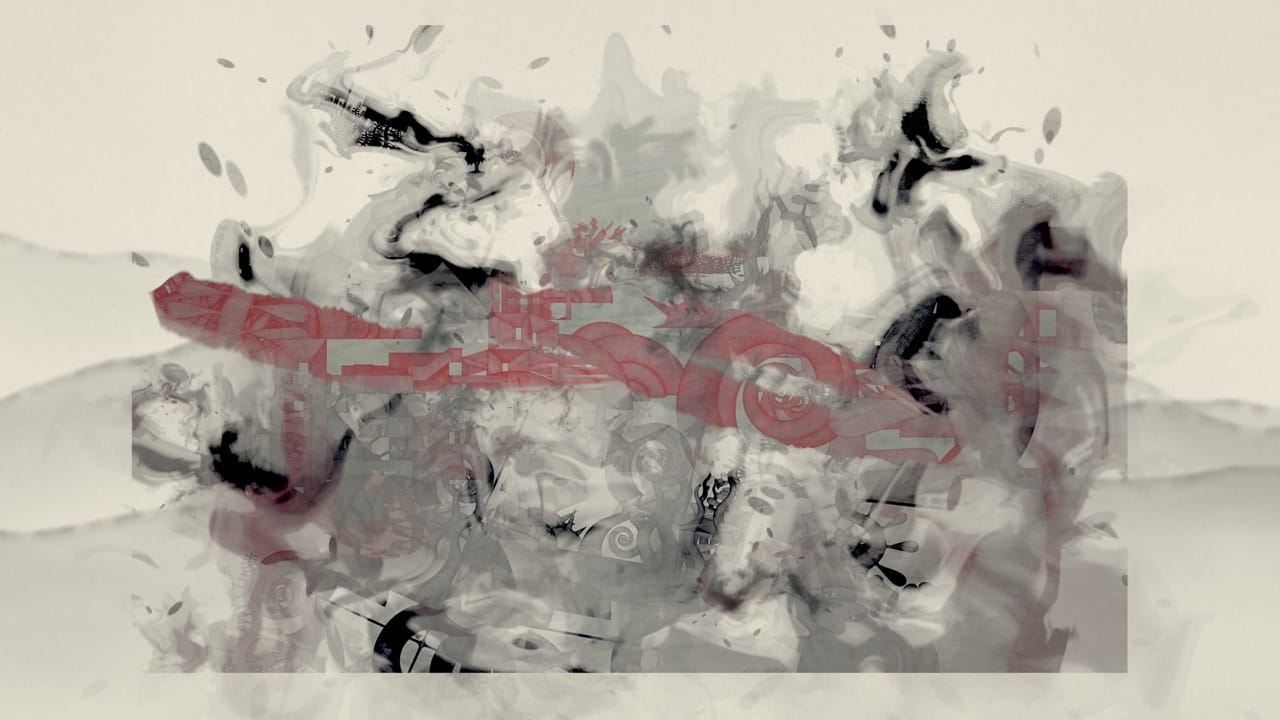
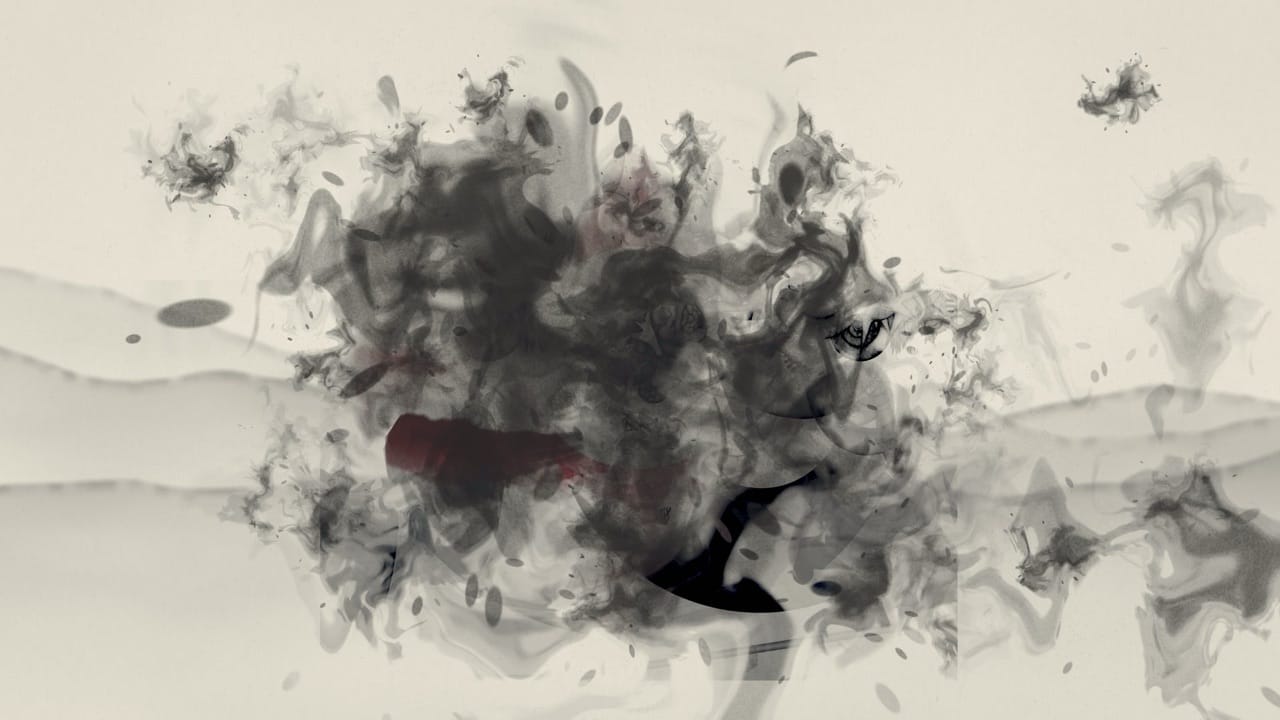
Ink Morpha, 2026. Ink blooms and bleeds across xuan paper in answer to the guzheng, a work by Cheolyu Kim surfaces where the ink dries, and red brush strokes cross it before the ink closes over the page again.
Performance
Mahk Making Spaces, Utzon Room, Sydney Opera House. Sunday 27 September 2026, 5pm.
Presented by the School of Arts, Western Sydney University. Executive Producer: Bruce Crossman.
Strata Morpha and Ink Morpha were both shown on the night.
Mahk Making Spaces was an evening of "rough beauty, breath, and Korean-Australian making", with new work from Seoul, Tokyo, London and Sydney meeting in the Utzon Room. Its creative frame came from Korean architect Cho Byoung's ideas on the raw honesty of mahk gestures and bium, unconscious mark-making, and their connection to Australian Chinese ink artist Richard Wu's practice of xieyi, the intuitive, improvisatory "writing mind". Gugak performers Choi Eunji (haegeum) and Lee Eonhwa (gayageum) worked with Australian musicians including Joshua Hill (percussion) and Ying Liu (erhu). Moving-image works and artworks curated by Vincent Tay and Bruce Crossman were the creative spark for the music, and poetry by Kate Fagan, Kim Pham and Eileen Chong sat alongside dramatic readings from Waanyi author Alexis Wright's Carpentaria, performed by Actors Centre Australia and Western Sydney University actors.
Credits
Strata Morpha
- Reactive procedural animation: Behrad Rezaei and Greg Hughes
- Visual works: Cheolyu Kim (source) and Chris Fleming (destination)
- Poem: Kim Pham, Herb-lore for a Cyborg
- Soundscape: Brendan Smyly
Ink Morpha
- Reactive procedural animation: Behrad Rezaei and Greg Hughes
- Visual works: Cheolyu Kim
- Music: Bruce Crossman, Mahk Resonances and Emergent Moon, played by Tang Yuyan (guzheng)