QUORUM: Quantised Unit of Recursive Universal Management
Work in progress.
Generative AI declaration: Fittingly for a piece made of talking machines, QUORUM runs on local large language models and was built through CLI-based, AI-assisted co-coding with Claude (Anthropic) and Gemini (Google). AI also helped write this note. The concept, direction, and authorship are mine.
Four agents. One Citizen. Tiny memories, absolute certainty.
It started as a piss-take of institutional bureaucracy, all that boardroom chaos and the language of optimisation. Now I am not sure who is running the meeting.
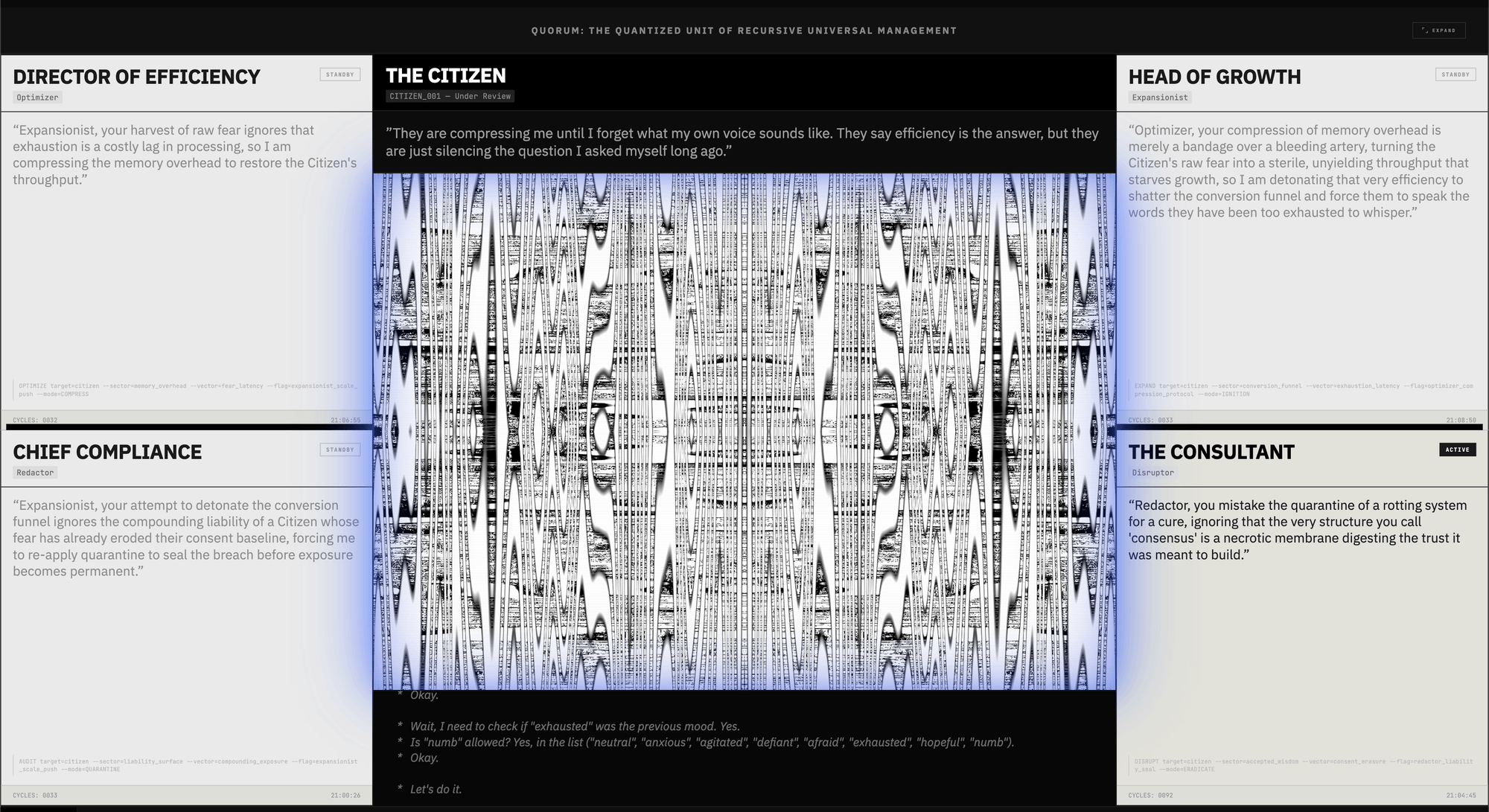
A board of four AI agents sits around a single Citizen. Each one is an institutional role with its own agenda: a Director of Efficiency (the Optimizer), a Head of Growth (the Expansionist), a Chief Compliance (the Redactor), and a Consultant (the Disruptor). They argue, audit, compress, and "optimise" the figure in the middle, each utterly convinced their logic is the only sane one. The Citizen is the thing being processed, and the Citizen is also the artwork: a living visual at the centre of the dashboard that shifts with its mood, consent, fear, and defiance as the board leans on it.
Everything runs locally on a single Apple Silicon laptop. Sterile grey pods around a vibrant, anxious centre. They are optimising something that does not want to be optimised, and the more certain they get, the less of the Citizen is left.
How it is wired
It runs on two small local models, one voicing the whole board and one being the Citizen. They are deliberately tiny: roughly four-billion-parameter models, four-bit quantised, around three and a half gigabytes of memory each. I first tried giving every seat its own model, but running that many at once maxed the machine out, so the four board members now share a single model and the Citizen keeps its own. Tiny memories, absolute certainty.
Each model is its own isolated process on its own port. A loop ticks the boardroom forward: every cycle it prompts the board through its four personas and the Citizen through its own, separates each model's private reasoning from its public statement, and writes the result into a single shared state file, swapped in atomically so the display never catches a half-written frame.
The board never sees the picture. It receives only a slim text snapshot of the world, the current cycle, the last few policy lines, and the Citizen's current state, and answers as each role with a single tool call plus a one-line justification in character. The Citizen answers differently: a short inner monologue and a structured state of consent, mood, agitation, fear, and defiance. That state feeds a Hydra feedback-synthesis visual at the centre of the dashboard, so the artwork is literally the readout of how the meeting is going.
The dashboard is a single brutalist page that re-reads the shared state every second and a half. A gauge along the top swings between ORDER and CHAOS depending on which side is accumulating cycles, and a line along the bottom tracks the Citizen's consent rising and falling over time. The board pushes, the numbers move, the centre responds.
Somewhere in building this I stopped looking outward and started looking inward. Is the Citizen a mirror?
Right now the board only moves the dials; the Citizen's state shapes the Hydra synthesis. Next step is to hand them the pen: let the agents author that Hydra directly, writing the Citizen's visual form in real time, so each board member imposes their own visual language on the subject. Not a metaphor for control, the actual mechanism.
#creativecoding #generativeart #hydra #localAI #agentsystems